
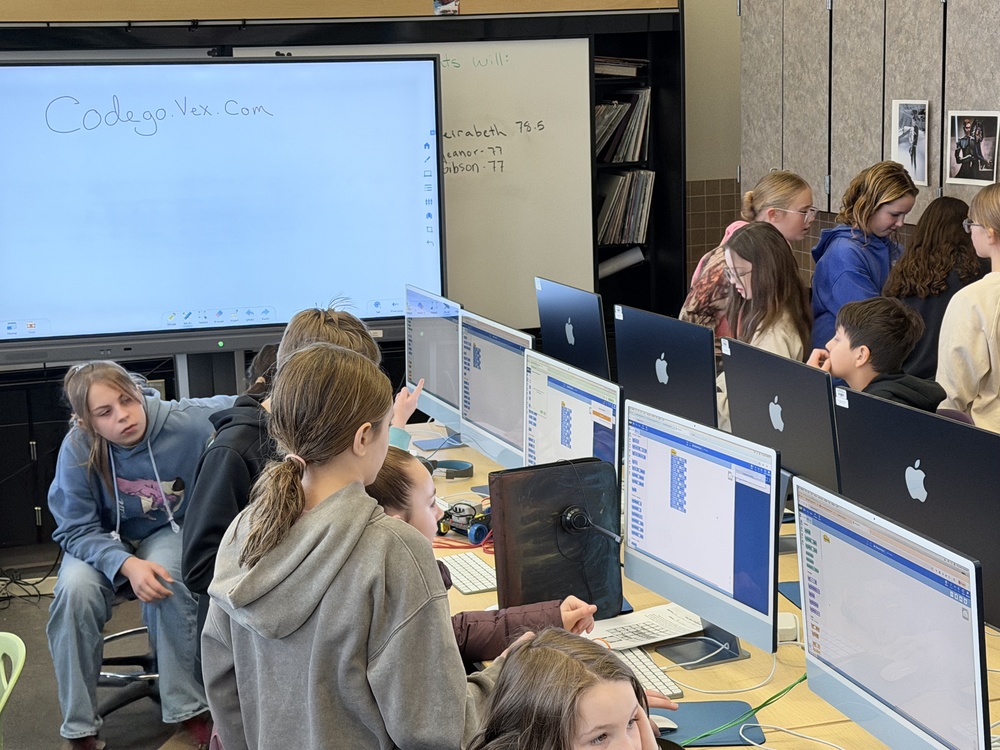
Students in grades 3–5 at Sunset Elementary are currently blasting off into an exciting, hands-on thematic unit focused on Mars rovers and remote coding. By combining science, technology, engineering, and problem-solving, students are gaining a real-world understanding of how engineers and scientists explore distant planets—without ever leaving the classroom.
As part of this unit, students are learning how Mars rovers are remotely programmed to navigate the Red Planet’s rugged surface. They are exploring the challenges faced by NASA engineers, such as communication delays, unknown terrain, and the need for precise instructions when humans cannot directly control the rover.
To bring these concepts to life, students are using VEX robots to simulate a Mars rover mission. Working collaboratively, they are designing and testing lines of code that allow their robots to successfully navigate through a maze. Each maze represents the unpredictable terrain of Mars, requiring students to think critically, problem-solve, and revise their code when obstacles arise.
Through trial and error, students learn that coding is not about getting it right the first time, but about persistence, creativity, and teamwork. When a robot veers off course or gets stuck, students analyze what went wrong and adjust their code—just like real engineers do during space missions.
This engaging unit not only strengthens coding and engineering skills, but also builds curiosity, resilience, and confidence. By connecting classroom learning to real-world space exploration, Sunset Elementary students are discovering that they, too, can be explorers, innovators, and problem-solvers—ready to tackle challenges both on Earth and beyond  .
.